
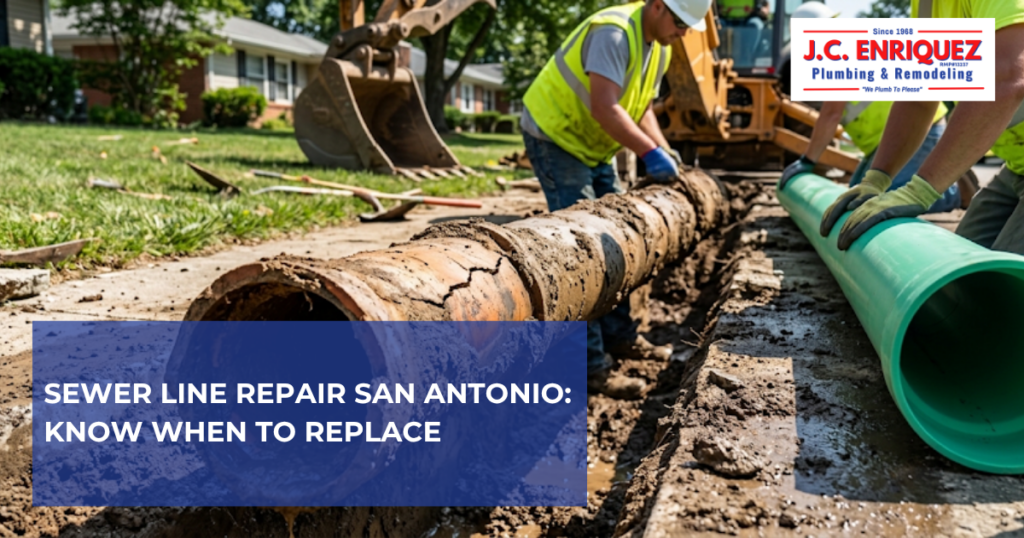
You flush the toilet and hear the shower drain gurgle. A few minutes later, dirty water starts rising in the tub. Then a plumber runs a camera and hands you a sewer line repair estimate that costs thousands of dollars.
Now comes the hard question. Is the pipe actually broken, or does it just need cleaning?
For San Antonio homeowners, a sewer line repair recommendation should start with evidence. Grease buildup, wipes, tree roots, an offset joint, a crushed section, and a fully collapsed pipe are different problems. They should not automatically get the same solution or price.
That distinction matters even more in 2026. SAWS currently tells homeowners with sewer backups to have a licensed plumber inspect the private line with a video camera and clear the blockage before determining whether the problem lies in the private lateral or the public sewer system.
This guide shows you how to read a diagnosis, compare sewer repair with sewer line replacement, understand current costs, and know when getting a sewer repair second opinion in San Antonio makes sense.
Do not approve a full sewer line replacement based on symptoms alone. A licensed plumber should clear enough of the blockage to perform a sewer camera inspection and identify whether the problem is buildup, roots, an isolated break, a sagging section, or widespread pipe failure. Localized damage may support spot repair or trenchless sewer repair, while repeated collapse, severe corrosion, or extensive structural failure may justify replacement. Ask to see the video and defect location before approving major excavation.
What Causes Sewer Line Problems in San Antonio Homes
Your home sewer line, often called the sewer lateral, carries wastewater from toilets, tubs, showers, sinks, and appliances toward the public sewer main. When that pipe stops flowing properly, the cause is not always structural damage.
Grease, wipes, and accumulated debris
Fats, oils, grease, wipes, and other solids can collect inside a sewer pipe. SAWS specifically warns that wipes do not break apart like toilet paper and can combine with grease, debris, tree roots, or pipe deformities to form major obstructions.
A buildup problem may respond to mechanical cleaning or hydrojetting. Hydrojetting uses controlled high-pressure water to scrub deposits from the pipe wall.
Tree root intrusion
Roots do not usually break into a perfectly sealed modern pipe for no reason. They enter through cracks, loose joints, or other openings where moisture escapes.
Once inside, roots catch toilet paper and waste. The clog returns because cutting the roots addresses the obstruction but not necessarily the opening that allowed them into the pipe.
Structural pipe damage
Older pipes can crack, separate, corrode, flatten, or collapse. A pipe belly is another problem. This means part of the sewer line has settled low enough to hold wastewater instead of maintaining proper downhill flow.
Pro Tip: A camera image showing roots proves roots are present. It does not automatically prove the entire sewer line needs replacement. Ask where the roots entered and how much of the pipe is structurally damaged.
Knowing the cause is the first step. The symptoms can help tell you how urgent the problem has become.
Warning Signs Your Sewer Line Needs Professional Attention
A single slow bathroom sink usually points to a local drain problem. Several fixtures acting up together are more concerning because they may share the same main drain or sewer lateral.
Watch for these sewer line damage signs in San Antonio homes:
- Multiple drains back up together. A toilet flush that pushes water into a tub or shower strongly suggests a downstream restriction.
- The lowest drain backs up first. First-floor showers, tubs, and floor drains often show main-line trouble before higher fixtures.
- Toilets gurgle when another fixture drains. Air struggling around a blockage can cause bubbling and gurgling.
- Sewage appears in a tub or shower. Stop using water in the home and call for sewer backup repair.
- A sewer smell keeps returning. A sewer smell plumber in San Antonio should check traps, vents, cleanouts, and the sewer lateral rather than masking the odor.
- The yard develops an unexplained wet or sunken area. A damaged underground line may allow wastewater to escape into surrounding soil.
- The same clog returns after cleaning. Recurring backups are one of the strongest reasons to request a sewer line inspection.
SAWS tells customers whose toilets and tubs begin backing up to call a licensed plumber to televise, meaning camera-inspect, the line and clear any blockage on their side of the public main.
Warning: Stop running washing machines, dishwashers, showers, and toilets once sewage begins backing up. Every gallon sent down the drain can make indoor contamination worse.
Those symptoms tell you something is wrong. The next question is what happens if the problem keeps getting postponed.
What Happens When Sewer Problems Are Ignored
A sewer clog can start as an inconvenience and end as a sanitation problem. When wastewater cannot move through the pipe, it looks for another exit.
That exit may be your shower, toilet, floor drain, sewer cleanout, or a damaged section underground.
SAWS notes that sanitary sewer overflows can contain bacteria, viruses, and disease-causing material. Children, older adults, and people with compromised immune systems may face greater risk from exposure.
Delay can also increase repair scope. A root blockage may initially need cleaning and inspection. If roots continue growing through a damaged joint, they can create larger openings and repeated backups.
A cracked or leaking lateral can also allow surrounding soil to move. That can worsen offsets or create voids around the pipe.
How costs can escalate
- Early problem: Drain cleaning and camera diagnosis.
- Recurring problem: Root cutting, hydrojetting, or localized sewer pipe repair.
- Structural deterioration: Excavation, trenchless rehabilitation, or sewer line replacement.
- Indoor backup: Plumbing repair plus sanitation, flooring, drywall, or contents cleanup.
Current national 2026 pricing data puts the average sewer line repair near $2,600, with many repairs between $1,100 and $4,100 before major restoration or unusually complex replacement work.
That makes an accurate diagnosis valuable. Spending money on the wrong repair is often more expensive than paying for proper inspection first.
Buildup, Roots, Pipe Damage, or Replacement: How to Tell the Difference
This is where a sewer line repair estimate should become specific. “Bad sewer line” is not a diagnosis.
| Camera Finding | Likely Problem | Common Next Step |
|---|---|---|
| Heavy grease or debris with intact pipe | Buildup | Cleaning or hydrojetting |
| Roots entering one joint | Root intrusion | Root removal plus repair evaluation |
| One cracked or separated section | Localized pipe damage | Spot repair or trenchless option |
| Standing water in a low section | Pipe belly | Regrading or replacement of affected section |
| Repeated severe offsets | Structural movement | Section replacement or broader rehabilitation |
| Pipe crushed or fully collapsed | Structural failure | Excavation or replacement |
| Widespread deterioration | End-of-life pipe | Partial or full sewer line replacement |
When buildup is the main problem
A camera should show deposits but an otherwise sound pipe. Cleaning may restore normal flow without digging.
Do not mistake a dirty pipe for a destroyed one.
When roots need more than cutting
Tree root sewer line repair in San Antonio should answer two questions: where did the roots enter, and what condition is the pipe around that entry point?
Cutting roots can restore flow. Repairing the defect helps stop the same problem from returning.
When replacement becomes reasonable
Full replacement becomes easier to justify when damage is widespread, several sections have collapsed, the pipe has lost structural integrity, or repeated repairs are no longer economical.
Plumber’s Advice: If someone recommends replacing dozens of feet of sewer pipe, ask to see the complete camera recording, footage counter, defect locations, and proposed repair limits.
If you already have a sewer line replacement estimate and the diagnosis still feels vague, get a second opinion before excavation begins. J.C. Enriquez and Son Plumbing provides licensed sewer line inspection and repair in San Antonio, with same-day service available for urgent backups.
DIY vs. Hiring a Licensed Plumber for Sewer Line Repair
You can make a sewer problem safer while waiting for help. Diagnosing or repairing the underground sewer itself is different.
What You Can Handle
You can safely:
- Stop using plumbing fixtures when the main line backs up.
- Keep children and pets away from contaminated water.
- Check whether an accessible sewer cleanout is overflowing without removing pressurized caps.
- Write down which fixtures backed up first.
- Take photos of visible sewage or yard symptoms.
- Find previous sewer repair records if you have them.
A sewer cleanout is an access fitting that lets a plumber reach the drain with cleaning and camera equipment.
When You Must Call a Pro
Main sewer line repair, collapsed sewer line repair, excavation, pipe bursting, and other permanent plumbing repairs belong with licensed professionals. Sewage exposure also requires proper safety precautions.
Texas consumers can verify the company’s Responsible Master Plumber through the Texas State Board of Plumbing Examiners. The Board advises homeowners to verify the Master Plumber license and certificate of insurance, obtain detailed written estimates, and check whether local permits are required.
San Antonio also requires licensed trade contractors for regulated plumbing project components. Depending on the repair location and scope, plumbing, excavation, or right-of-way permits may apply.
Do Not Do This: Do not repeatedly pour chemical drain cleaner into a backed-up sewer line. It rarely corrects roots or structural failure and can leave caustic chemicals in the pipe where plumbers must work.
A homeowner can control water use. A qualified plumber should determine why the sewer failed.
How Professional Sewer Line Diagnosis and Repair Works
A reliable sewer repair service should narrow the problem before recommending major replacement.
Step 1: Confirm the backup pattern, 10 to 20 minutes
The plumber checks affected fixtures, cleanouts, previous repairs, and whether the problem appears local or main-line related.
Step 2: Open and clear access, 20 to 90 minutes
If heavy debris blocks the camera, the line may need cable cleaning or root cutting first. A camera cannot diagnose pipe condition if it cannot travel through the obstruction.
Step 3: Perform the sewer camera inspection, 20 to 60 minutes
A waterproof camera moves through the lateral. The plumber looks for grease, roots, cracks, offsets, bellies, corrosion, and collapse.
The camera footage should include distance measurements so defects can be located from the surface.
Step 4: Locate the defect, 10 to 30 minutes
An electronic locator can identify the camera head underground. That helps determine whether the problem is under the yard, driveway, foundation area, street, alley, or easement.
This is especially important in San Antonio because SAWS has a process for qualifying private-lateral problems discovered beyond the homeowner’s property.
Step 5: Compare repair methods, 15 to 30 minutes
Options may include cleaning, hydrojetting, spot excavation, trenchless lining where technically appropriate, pipe bursting, or conventional sewer line replacement.
Step 6: Complete repair, several hours to several days
Time depends on length, depth, access, utilities, soil, surface restoration, inspection requirements, and repair method.
Step 7: Re-camera and test the line, 20 to 45 minutes
A final camera pass documents the repaired pipe and verifies flow.
Post-repair checklist:
- Keep before-and-after camera footage.
- Save permits and inspection records.
- Get warranty terms in writing.
- Record the repaired section and depth.
- Ask whether maintenance cleaning is recommended.
- Keep the final paid invoice for future resale or insurance questions.
The process should leave you with evidence, not just a repaired drain.
Sewer Line Repair Cost in San Antonio in 2026
Sewer line repair San Antonio pricing varies sharply because a 3-foot spot repair is not the same job as replacing 70 feet beneath a driveway.
Your sewer line repair estimate San Antonio homeowners receive should explain:
- How much pipe needs work
- Depth and location of the defect
- Repair method
- Labor and materials
- Permit costs
- Excavation and utility locating
- Concrete, driveway, or landscaping restoration
- Camera inspection
- Cleanup
- Parts and workmanship warranty
If work enters the public right-of-way, San Antonio has separate permitting rules. Current City information lists a $170 point-repair permit fee for certain utility excavation or non-excavation work of 49 feet or less in the right-of-way. Larger projects follow different requirements.
Financing can also matter on a major sewer line replacement. J.C. Enriquez and Son Plumbing offers financing options for qualifying larger plumbing projects.
Before choosing the cheapest quote, make sure you are comparing the same scope.
How to Choose a Sewer Repair Plumber in San Antonio
A sewer repair second opinion in San Antonio is reasonable when the recommendation jumps straight from “backup” to “replace everything.”
The Texas State Board of Plumbing Examiners gives consumers a practical starting point. Ask for the company’s Responsible Master Plumber and verify the license through the Board’s public resources.
Use this checklist:
- Verify the Responsible Master Plumber’s license.
- Confirm a current certificate of insurance.
- Ask for the complete sewer camera recording.
- Request defect locations and footage measurements.
- Get the repair scope and warranty in writing.
- Ask whether permits or inspections apply.
- Compare repair and replacement options.
- Ask who restores concrete, landscaping, or flooring.
- Confirm whether a follow-up camera inspection is included.
The State Board also recommends getting multiple price estimates and written warranty terms. Plumbing prices themselves are not set by the Board.
Manufacturer certifications such as Rheem ProPartner or Navien programs matter more for water heaters and equipment than sewer pipe work. For sewer repair, licensing, camera documentation, excavation experience, trenchless training, insurance, and written warranties are more relevant credentials.
PHCC membership and BBB accreditation can add trust signals, but neither replaces license verification.
J.C. Enriquez and Son Plumbing has served the San Antonio area since 1968 across three generations. The company holds Texas plumbing license PM-13237 and serves San Antonio, Helotes, Cibolo, Schertz, Converse, Live Oak, Windcrest, Boerne, and nearby communities.
When reading Google, Yelp, Nextdoor, BBB, Angi, or HomeAdvisor reviews, look for details about sewer diagnosis, communication, cleanup, punctuality, and whether the quoted price matched the completed work.
A strong plumber should be comfortable showing why the proposed repair is necessary.
Heavy Rain, Local Sewers, and Preventive Maintenance in San Antonio
San Antonio weather can expose sewer weaknesses that stay hidden during ordinary conditions.
In April 2026, SAWS reported that localized flooding and heavy rain contributed to the collapse of a 24-inch public concrete sewer main. That incident involved public infrastructure, not a private residential lateral, but it shows why drainage and soil conditions matter around underground piping.
Heavy rain does not automatically cause a healthy private sewer pipe to fail. However, existing cracks, poor joints, soil movement, root intrusion, or illegal stormwater connections can make backup symptoms more noticeable during wet periods.
Local SAWS responsibility matters
When toilets and tubs back up, SAWS currently instructs homeowners to call a licensed plumber first. The plumber should camera-inspect the private line and clear the blockage.
If the licensed plumber determines the obstruction or defect lies beyond the property in the right-of-way, street, alley, or easement, SAWS may inspect the problem and qualifying customers may be eligible for reimbursement of certain normal plumbing expenses through its Sewer Lateral Reimbursement Program.
That makes accurate electronic locating especially important.
Preventive sewer maintenance checklist
- Never flush wipes, even when labeled flushable.
- Keep fats, oils, and grease out of drains.
- Schedule camera inspection after repeated main-line backups.
- Address root intrusion before it becomes a dense obstruction.
- Repair broken sewer cleanout caps.
- Keep large trees monitored near known sewer routes.
- Save previous camera footage for comparison.
- Investigate recurring backups after heavy rain.
SAWS recommends flushing only what it calls the “3 Ps”: pee, poop, and toilet paper.
Preventive cleaning may cost hundreds. A collapsed sewer line repair can cost thousands.
Homeowners Also Ask About Sewer Line Repair
How do you know if a sewer line really needs replacement?
A camera inspection should show structural evidence. Look for collapsed sections, widespread cracking, major offsets, severe corrosion, repeated bellies, or damage across enough of the pipe that spot repairs no longer make financial sense. Roots or buildup alone do not automatically prove full replacement is necessary. Ask your plumber to show the camera footage and explain each damaged section.
Can tree roots in a sewer line be repaired without replacing everything?
Often, yes. Roots can sometimes be cut or hydrojetted to restore flow, then the entry point can be evaluated for localized repair or rehabilitation. If roots have entered through one damaged joint, replacing the entire lateral may be unnecessary. If roots appear throughout deteriorated pipe with repeated cracks and separations, broader replacement may make more sense.
Should I get a second opinion on a sewer line replacement estimate?
Yes, especially when the project involves major excavation or a five-figure estimate. A sewer repair second opinion should include an independent camera inspection, defect locations, and comparison of spot repair, trenchless methods, and conventional replacement. The second plumber should be able to explain why each option does or does not fit the pipe condition.
Who is responsible if the sewer problem is outside my San Antonio property?
SAWS advises homeowners to start with a licensed plumber who cameras and clears the private lateral. If the plumber locates the problem beyond the property in the right-of-way, street, alley, or easement, SAWS can investigate. In qualifying cases, its Sewer Lateral Reimbursement Program may reimburse certain normal plumbing expenses.
Why does my sewer line keep backing up after it was cleaned?
Cleaning removes an obstruction, but it may not repair the condition that caused it. Recurring backups can come from tree roots entering a cracked joint, a pipe belly that holds waste, a structural offset, deteriorated piping, or repeated grease and wipe accumulation. Ask for a camera inspection after the line is cleared so the underlying cause can be seen.
Frequently Asked Questions
Q: How much does sewer line repair cost in San Antonio?
A: Sewer repair varies from several hundred dollars for cleaning to several thousand for structural repair. Current national 2026 data places many sewer repairs between $1,100 and $4,100, with an average near $2,600. Long, deep, or difficult replacements can cost much more. Get a written local estimate based on camera findings.
Q: How long does sewer line repair take?
A: Cleaning and camera inspection can sometimes be completed in a few hours. A small excavation may take one day, while extensive sewer line replacement can take several days. Permitting, utility locates, weather, pipe depth, concrete removal, and restoration can extend the schedule. Your estimate should separate plumbing time from surface restoration.
Q: Does sewer line replacement require a permit in San Antonio?
A: Permit requirements depend on the scope, location, and whether work affects private property or the public right-of-way. San Antonio requires licensed trade contractors for regulated plumbing work, and separate right-of-way permits may apply when excavation reaches public areas. Your plumber should identify required permits before work begins.
Q: What warranty should come with sewer line repair?
A: Warranty terms vary by repair method. Ask for written coverage that states which pipe sections, materials, labor, and failure types are covered. Also ask whether stoppages caused by grease, wipes, new root growth, soil movement, or unrelated sections are excluded. Keep your invoice, camera footage, and warranty together.
Q: Does J.C. Enriquez and Son Plumbing provide sewer repair in communities outside San Antonio?
A: Yes. J.C. Enriquez and Son Plumbing serves San Antonio and surrounding communities including Helotes, Cibolo, Schertz, Converse, Live Oak, Windcrest, Boerne, and nearby areas. Call to confirm scheduling for your address and whether same-day sewer inspection is currently available.
Q: Should the plumber provide camera footage with my estimate?
A: For a major sewer repair or replacement recommendation, seeing the footage is a reasonable request. The video helps you understand whether the problem is debris, roots, cracking, separation, a belly, or collapse. Ask for footage measurements and surface locations so you can compare estimates accurately.
Get a Clear Sewer Diagnosis Before You Dig
A sewer backup is stressful enough. You should not also have to wonder whether the repair you were quoted is actually necessary.
J.C. Enriquez and Son Plumbing provides licensed sewer line repair San Antonio homeowners can turn to for camera inspection, sewer diagnosis, repair, replacement, and urgent backup service. With three generations serving San Antonio since 1968, the team focuses on clear recommendations, upfront pricing, and work built to last.
Call 210-679-6020 now to schedule a sewer line inspection or request a second opinion in San Antonio, TX, Helotes, Cibolo, Schertz, Converse, and surrounding communities. Sewage backups can create property and sanitation risks, so recurring symptoms deserve prompt attention.