
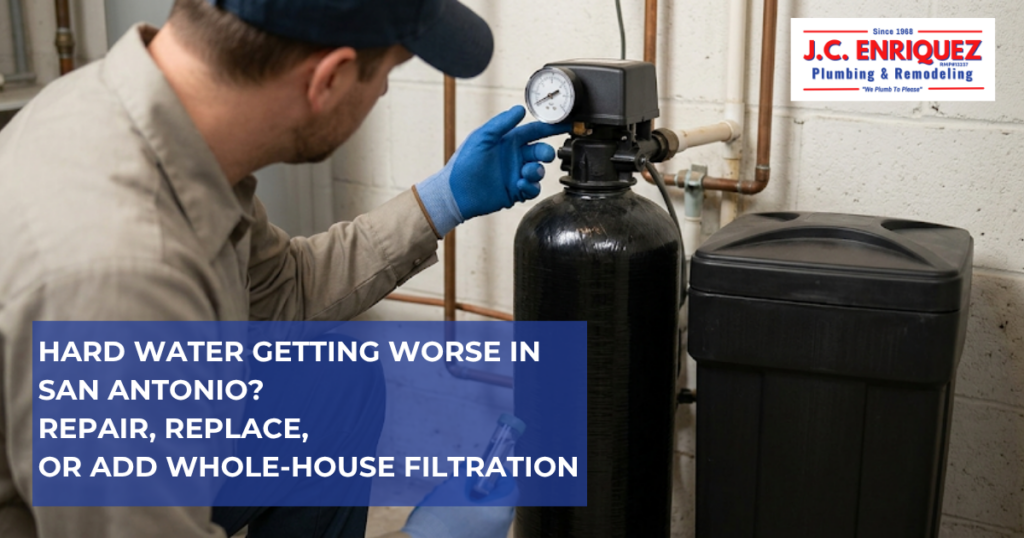
Repair the softener when the tank, resin, and control system are still in good condition and the problem involves a serviceable valve, injector, seal, or programming issue. Replace it when the unit is old, undersized, cracked, leaking repeatedly, or no longer reduces hardness after proper service. Add whole house water filtration when your goals include reducing sediment, chlorine taste, odor, or a specific tested contaminant, because a softener mainly targets hardness minerals.
You pull a clean glass from the dishwasher and find cloudy spots baked onto it. The showerhead sprays sideways. Your faucets have a chalky white crust, and your skin feels dry even after changing soap. Those are common reasons homeowners begin searching for water softener repair San Antonio service.
San Antonio Water System reports typical hardness of about 15 to 20 grains per gallon. That is very hard water. It is generally safe to drink, but the calcium and magnesium in it can leave scale on fixtures, reduce soap performance, and make water-using equipment work harder.
The right solution is not always a new softener. A sticking control valve may need repair. An undersized or worn-out system may need replacement. Taste, odor, chlorine, or sediment concerns may call for whole house water filtration instead.
This 2026 guide will help you compare those options without buying equipment your home does not need.
Why Hard Water Problems Develop in San Antonio Homes
Hard water contains dissolved calcium and magnesium. A traditional softener uses ion exchange, a process that captures those hardness minerals in a resin tank and exchanges them for sodium or potassium ions.
SAWS says its typical water hardness ranges from 15 to 20 grains per gallon. One grain per gallon equals about 17.1 milligrams per liter, which places much of the local supply well into the very hard range.
Mineral scale builds gradually
Calcium scale forms faster where water gets heated. Water heaters, dishwashers, coffee makers, showerheads, and hot-water fixtures often show trouble first.
The scale may look like a cosmetic issue, but it can narrow openings, coat heating surfaces, and make valves harder to operate. Homeowners often notice the damage before they realize the softener stopped regenerating correctly.
The softener may not match household demand
A system must be sized for hardness, household water use, and peak flow. An undersized softener regenerates too often or allows hardness through before the next cycle.
A larger family, additional bathroom, frequent guests, or new high-flow fixtures can push an older system beyond its original design.
The unit may have a mechanical or salt problem
Common failures include a clogged injector, salt bridge, stuck control valve, exhausted resin, blocked drain line, or incorrect programming. A salt bridge is a hardened layer inside the brine tank that makes it look full even though salt is not dissolving below it.
Pro Tip: Do not judge softener performance by salt level alone. Test hardness at an untreated outdoor faucet and at an indoor softened-water tap. The difference shows whether the system is actually removing minerals.
Understanding the cause makes the next decision much easier.
Warning Signs Your Water Softener Needs Attention
A failing softener rarely stops in one dramatic moment. Performance usually slips over several weeks or months.
Watch for these signs:
- White scale returns quickly. Chalky deposits on faucets, shower glass, and appliances suggest hardness is passing through the system.
- Soap stops lathering well. Hardness minerals react with soap and leave residue on skin, tubs, clothing, and dishes.
- Water feels different. Properly softened water often feels smoother. A sudden return to a dry or sticky feeling deserves testing.
- The unit uses too much salt. Excess salt use may point to incorrect settings, a leaking valve, or unusually frequent regeneration.
- The salt level never drops. A salt bridge, clogged injector, or brine draw problem may prevent the unit from regenerating.
- Water tastes salty. Persistent salty taste can result from valve timing, drain restrictions, or an incomplete rinse cycle.
- The system runs or drains constantly. A control valve stuck in regeneration can waste water and needs prompt service.
A change in taste or odor does not automatically mean the softener failed. Softeners target calcium and magnesium. They are not designed to solve every water-quality concern.
Warning: Do not pour household chemicals, bleach, or unapproved cleaners into a brine tank. Use only products allowed by the equipment manufacturer, and disconnect power before inspecting moving or electrical components.
Once these signs appear, delaying service can affect more than the treatment unit.
What Happens When You Delay Water Treatment Service
Hard water damage is cumulative. It develops a little each time water evaporates or passes across a heated surface.
Scale can clog aerators, reduce shower flow, stiffen faucet cartridges, and leave deposits around toilet fill valves. Water heaters may also collect sediment and mineral buildup, especially when maintenance has been skipped.
The problem can spread in several ways:
- Fixtures become harder to clean. Mineral deposits trap soap residue and make surfaces look dirty soon after cleaning.
- Appliances work harder. Dishwashers, washing machines, ice makers, and water heaters may lose performance.
- Small valves begin sticking. Shutoff valves and fixture components can become harder to operate.
- Repair costs multiply. A serviceable control-valve issue can turn into resin damage, continuous draining, or full system replacement.
A $200 to $500 service visit may prevent a larger equipment purchase, depending on the diagnosis. It may also reduce future spending on damaged fixtures and appliance components.
The EPA’s 2026 water-softener guidance notes that conventional units use water during regeneration. A typical softener can use about 20 to 70 gallons per regeneration cycle, while some larger systems use more.
A malfunctioning unit that regenerates too often can therefore waste both water and salt. That matters in a drought-conscious region like San Antonio.
The next step is deciding which type of service gives your home the best value.
Water Softener Repair vs. Replacement vs. Filtration
These three services solve different problems. Treating them as interchangeable leads to disappointing results.
| Option | Best for | Main limitation |
|---|---|---|
| Water softener repair | Valve faults, clogged injectors, salt bridges, programming errors, minor leaks | May not make sense for a very old or undersized unit |
| New water softener installation | Persistent hardness, failed resin, cracked tanks, repeated breakdowns | Does not target every taste, odor, or contaminant concern |
| Whole house water filtration | Sediment, chlorine taste, odor, and selected contaminants | Does not necessarily remove hardness |
| Combined treatment system | Homes with both hardness and filtration goals | Higher upfront cost and more maintenance components |
Choose repair when the core system is sound
Repair often makes sense when the pressure vessel is intact, the resin still performs, and replacement parts are available. Control valves, seals, injectors, brine components, and drain restrictions can often be corrected.
Water softener repair Converse or Timberwood Park homeowners request may be especially worthwhile when the equipment is only a few years old.
Choose replacement when reliability is gone
Replacement usually makes more sense when the unit is around 10 to 15 years old, leaks repeatedly, has cracked components, or cannot meet current household demand. Age alone is not the deciding factor, but it affects parts availability and expected service life.
A properly sized water softener installation in San Antonio should account for measured hardness, household size, flow rate, and daily water use.
Choose filtration for a different treatment goal
Whole house water filtration treats water as it enters the home. Depending on the media, it may reduce sediment, chlorine taste, odor, or specific contaminants.
The CDC recommends choosing treatment based on the chemicals or germs you actually want to reduce. NSF certification claims should match that goal.
If hard water and taste concerns exist together, a combined softener and carbon filtration system may be the right design.
If you are already seeing scale, salty water, constant regeneration, or unexplained changes in water quality, there is no need to guess. J.C. Enriquez and Son Plumbing, Heating & Cooling provides same-day water softener service in San Antonio and nearby communities, with licensed diagnosis and upfront recommendations.
DIY Checks vs. Calling a Licensed Plumber
You can perform a few safe checks before scheduling service. Keep the inspection simple and stop if water or electrical components create a hazard.
What You Can Handle
- Check whether the unit has power and displays an error code.
- Confirm the bypass valve is in the service position.
- Look for an obvious salt bridge using a clean wooden handle.
- Check the salt type against the manufacturer’s instructions.
- Review the programmed hardness and regeneration time.
- Inspect the floor for drips near the brine tank or control head.
- Test water hardness with a basic test kit.
If you break a salt bridge, do it gently. Do not strike the tank or force sharp tools into the salt.
When You Must Call a Pro
Call a licensed plumber when the system leaks, drains continuously, produces salty water, has a damaged bypass, or requires changes to household plumbing. You should also call when installing a new point-of-entry system, which treats water where the main line enters the home.
Texas regulates plumbing work through the Texas State Board of Plumbing Examiners. The City of San Antonio also states that plumbing contractors must register their state plumbing license before obtaining permits.
Do Not Do This: Do not cut the main line, alter drainage, or install a treatment system without checking local requirements. Incorrect placement can reduce flow, create cross-connection concerns, flood the home, or make future service difficult.
A licensed plumber can also determine whether a permit applies to the exact scope. Requirements may differ inside San Antonio, Converse, Schertz, Universal City, Helotes, Cibolo, and unincorporated areas.
Safe checks help gather information. They do not replace proper diagnosis.
How Professional Water Treatment Service Works
A good service call starts with your goals, not a sales pitch. The plumber should determine whether you have a hardness problem, equipment problem, filtration goal, or a combination.
- Review symptoms and equipment history, 10 to 15 minutes The plumber asks about scale, taste, salt use, regeneration frequency, water pressure, and prior repairs.
- Test untreated and treated water, 10 to 20 minutes Hardness is measured before and after the softener. Additional testing may be recommended when taste, odor, sediment, or health-related concerns exist.
- Inspect the softener, 20 to 40 minutes The control valve, injector, brine draw, resin tank, bypass, drain line, and programming are checked.
- Measure flow and household demand, 10 to 20 minutes Proper sizing depends on hardness, water use, bathroom count, household size, and peak flow.
- Compare repair and replacement options, 10 to 15 minutes You should receive an explanation of expected service life, parts availability, warranty coverage, and operating costs.
- Complete repair or installation, 1 to 6 hours Minor repairs may take less than an hour. A new softener or whole-house filtration installation may require several hours, depending on access and piping.
- Sanitize, program, and test the system, 20 to 45 minutes The plumber checks for leaks, confirms regeneration settings, tests treated water, and explains maintenance.
Ask about systems certified to relevant standards. NSF/ANSI 44 applies to residential ion-exchange softeners. NSF/ANSI 42 covers aesthetic claims such as chlorine, taste, and odor reduction, while NSF/ANSI 53 addresses specified contaminants with health effects.
Installation checklist:
- Written equipment model and capacity
- Measured source-water hardness
- Bypass valve and service clearance
- Proper drain connection
- Warranty for equipment and labor
- Maintenance and filter schedule
- Final hardness test
This process creates a recommendation you can verify, not just a bigger equipment quote.
Water Softener and Filtration Costs in San Antonio for 2026
Pricing depends on system type, capacity, plumbing access, drain availability, electrical needs, filtration goals, and whether old equipment must be removed.
National 2026 guides place many complete softener projects between roughly $1,300 and $5,500, although local access and equipment quality can move the final cost higher or lower.
A legitimate estimate should include equipment, labor, fittings, drain work, old-unit removal, programming, startup testing, permit handling if required, and warranty terms.
Red flags include a quote with no model number, no capacity calculation, no hardness test, or no Responsible Master Plumber license number. The Texas State Board advises consumers to obtain detailed written estimates and says invoices should include the Responsible Master Plumber’s license number.
Financing may be helpful when whole-house treatment is part of a larger plumbing project. J.C. Enriquez and Son Plumbing offers financing options for qualifying home-service work.
How to Choose a Water Treatment Plumber in San Antonio
Water treatment combines plumbing, equipment sizing, water testing, drainage, and maintenance. Choose a contractor who understands all of them.
Use this hiring checklist:
- Verify the Responsible Master Plumber through the Texas State Board of Plumbing Examiners.
- Confirm general liability insurance and bonding.
- Ask whether the contractor is registered with the applicable city.
- Request measured hardness and written sizing calculations.
- Ask which NSF or ANSI standards apply to the proposed equipment.
- Get equipment and workmanship warranties in writing.
- Ask who will service the unit after installation.
- Review verified feedback on Google, BBB, Yelp, Angi, HomeAdvisor, and Nextdoor.
Manufacturer experience also matters. Ask whether the plumber services the actual control valve and equipment line being proposed. A logo on a truck does not prove certification, so request current documentation for any claimed manufacturer credential.
Local companies have an advantage because they understand SAWS hardness, regional plumbing layouts, slab-foundation homes, garage installations, outdoor equipment exposure, and local permitting offices.
J.C. Enriquez and Son Plumbing, Heating & Cooling is a family-owned, three-generation San Antonio contractor founded in 1968. The company holds plumbing license PM-13237 and serves San Antonio, Helotes, Converse, Schertz, Cibolo, Universal City, Timberwood Park, and surrounding communities.
Look beyond the total star rating when reading reviews. Authentic reviews mention the problem, diagnosis, technician communication, cleanliness, price explanation, and how the system performed afterward.
The right contractor should be willing to recommend repair when repair makes sense.
Local and Seasonal Factors Across the San Antonio Area
San Antonio’s hard water does not mean the municipal supply is unsafe. SAWS says hard water is not considered a health hazard, and the utility publishes annual EPA-required water-quality results.
The 2026 SAWS report is based on testing performed in 2025. It gives homeowners a current public source for evaluating local water quality before buying treatment equipment.
Local hardness varies by supply and service area
SAWS reports a typical range of 15 to 20 grains per gallon, but actual hardness can vary. Homes in Converse, Universal City, Schertz, Helotes, Timberwood Park, and nearby areas may receive water from different systems or blends.
Test the water at the specific home before sizing equipment.
Summer demand changes softener performance
Hot weather can increase irrigation, bathing, laundry, guest use, and overall household demand. Although outdoor irrigation is usually left unsoftened, higher indoor use can still increase regeneration frequency.
Check salt, error codes, and drain activity before peak summer demand. A preventive visit is cheaper than discovering hard water after scale spreads through the house.
Freezing weather can damage exposed systems
San Antonio winters are usually mild, but hard freezes do happen. Softeners installed outdoors or in unconditioned spaces need insulation, weather protection, and proper drainage.
Filtration should match a verified goal
The CDC recommends selecting treatment based on the contaminants or qualities you want to address. A carbon filter may improve chlorine taste and odor. A sediment filter captures particles. A softener reduces hardness.
Reverse osmosis is usually a point-of-use drinking-water option, not a replacement for whole-home softening. EPA notes that inefficient RO systems can waste five or more gallons for each gallon treated, although WaterSense-labeled models must meet efficiency requirements.
With local factors covered, the most common homeowner questions become easier to answer.
Homeowners Also Ask About San Antonio Hard Water
Is San Antonio water considered very hard?
Yes. SAWS reports typical hardness of 15 to 20 grains per gallon, which falls in the very hard range. Hardness is caused mainly by dissolved calcium and magnesium. It is not usually a health concern, but it can create scale, water spots, soap residue, and added wear on fixtures and appliances. A properly sized softener can reduce those minerals throughout the home.
How do I know whether my softener needs repair or replacement?
Start with age, service history, hardness testing, leaks, and parts availability. A younger unit with a clogged injector, salt bridge, or valve problem may be worth repairing. Replacement becomes more practical when the tank cracks, resin no longer performs, repairs repeat, or the system cannot keep up with household use. Get both options in writing.
Is whole-house filtration better than a water softener?
Neither is universally better because they perform different jobs. A water softener removes hardness minerals through ion exchange. Whole house water filtration may reduce sediment, chlorine taste, odor, or selected contaminants, depending on its media and certification. Many San Antonio homes benefit from softening alone. Others need a combined softener and carbon filter.
Does a water softener make San Antonio tap water safer?
A softener is not a general-purpose safety device. It mainly reduces calcium and magnesium. SAWS already treats municipal water to meet drinking-water requirements. Use a certified filter only when you have a specific treatment goal, such as chlorine taste, sediment, or a tested contaminant. Match the product’s certification claim to the issue you want addressed.
How often should a water softener be serviced?
Check salt and visible operation monthly. Have the unit inspected when hardness returns, salt use changes, or regeneration becomes abnormal. Many homes benefit from professional service every one to two years, depending on equipment, hardness, water use, and manufacturer requirements. Filters may need more frequent replacement, often every few months to one year.
Frequently Asked Questions
Q: How much does water softener repair cost in San Antonio?
A: Minor water softener repair in San Antonio may cost about $200 to $600, while valve or resin work can cost more. Brand, age, parts availability, access, and the exact failure all affect pricing. Ask for a hardness test, diagnosis, written scope, and warranty before approving work.
Q: How long does water softener installation take?
A: A standard replacement often takes two to four hours when plumbing, drainage, and power are already available. A first-time installation or combined filtration system may take four to six hours or longer. The plumber should also program, sanitize, test, and explain the system before leaving.
Q: Do I need a permit for water softener installation in San Antonio?
A: Permit requirements depend on the scope and location. Plumbing contractors must register their Texas plumbing license with San Antonio before obtaining permits. Ask the contractor to confirm whether the proposed piping, drainage, or electrical-adjacent work requires a permit for your exact address.
Q: What warranty should come with a new softener?
A: Warranty terms vary by brand and component. Ask for separate written coverage for the control valve, resin tank, brine tank, electronics, parts, and installation labor. Also ask who handles warranty service and whether registration is required. Keep the final hardness test and startup records.
Q: Can I combine water softening and whole-house filtration?
A: Yes. A combined system can reduce hardness while also addressing sediment, chlorine taste, or odor. The order and sizing of components matter because incorrect design can reduce pressure or shorten media life. A plumber should test the water, calculate flow demand, and select certified equipment.
Q: Does J.C. Enriquez and Son Plumbing serve communities outside San Antonio?
A: Yes. J.C. Enriquez and Son Plumbing, Heating & Cooling serves San Antonio and surrounding communities, including Helotes, Converse, Schertz, Cibolo, Universal City, Timberwood Park, Live Oak, Windcrest, and nearby areas. Call to confirm same-day availability at your address.
Get Clear Answers Before Buying New Equipment
Hard water will not improve on its own, but that does not mean every homeowner needs the most expensive system. J.C. Enriquez and Son Plumbing, Heating & Cooling provides licensed water softener repair San Antonio homeowners can trust, plus new installation and whole house water filtration options based on your actual water and household demand.
Call 210-679-6020 to schedule same-day service or request an upfront estimate in San Antonio, TX, Helotes, Converse, Schertz, Cibolo, Universal City, or Timberwood Park.